
MILWAUKEE COUNTY LANDMARKS
Whitefish Bay


 Russell Barr Williamson House
4860 North Oakland Avenue
Whitefish Bay
Landmark Designation: 1977
Russell Barr Williamson came to Milwaukee in 1918 after several years as supervisor of architectural planning in the office of Frank Lloyd Wright. For a time, Barr designed houses as a member of the American Builders Service, but later, on his own, created smaller homes with an emphasis on economy. Williamson returned however to the long, low “prairie” profile in 1921 for his own home which has a cross axial plan with the wings protecting a private garden area. Its similarity to a house designed by Wright in Kansas City has been noted. Williamson designed his own furniture for the living room, dining room and sunroom which are separated only by low planters. Williamson and his wife lived here for nineteen years and then moved to Oostburg, Wisconsin where he continued his practice until his death at the age of 71. Williamson’s best known work in Milwaukee is the Eagle’s Club, built in 1925 at 2401 West Wisconsin Avenue.
Ernest Flagg Houses
4601 North Murray Avenue
1916 East Glendale Avenue
4600 North Cramer Street
Whitefish Bay
Landmark Designation: 1979
These three adjacent homes built between 1924 and 1926 are representative of a group of small homes built by the Arnold F. Meyer & Company. Meyer constructed nearly twenty similar homes in the Milwaukee area based on designs by nationally known architect Ernest Flagg. In a publication entitled Small Homes: Their Economic Design and Construction, Flagg set forth his guidelines for homes designed to cost less than $10,000. Savings in both labor and materials were suggested through the omission of expensive hardware and trim and the use of prefabricated plumbing parts which could be installed by unskilled laborers.
Homes designed according to the Flagg system plan have steep roofs and a ridge dormer or skylight which provides good summer ventilation. There are also casement windows and several chimneys. Ceilings are beamed and bathroom floors are higher than those of adjoining rooms to make space for plumbing equipment. Flagg system homes are especially interesting today because they have been found to conserve energy.
Pandl’s Whitefish Bay Inn
5200 North Lake Drive
Whitefish Bay
Landmark Designation: 1984
Pandl’s Whitefish Bay Inn is believed to be one of the oldest restaurants in the Milwaukee area operating at its original location. It was first owned by George Bently and called Bently’s Whitefish Bay Inn. This combination tavern-grocery store also served food and was built around 1900 on farmland across from the famous Pabst Whitefish Bay Resort. The Inn ’s patrons were visitors to the nearby Pabst resort and later troops from a local National Guard Armory.
A barn was located at the back of the Inn to accommodate travelers’ teams and wagons. In 1915, John and Anna Pandl bought the Inn with the intention of turning it into a family-style restaurant, even though most of the surrounding area was still farmland. The screened porch was enclosed and turned into the main dining room of Pandl’s Whitefish Bay Inn, while the backrooms were converted into kitchens.
When John Pandl died in 1932, the management of the restaurant was left to his wife, Anna and two sons, George and Jack. The family remodeled the Inn in 1934 but kept the décor fairly simple. When George left to establish his own restaurant in Bayside, Jack took over the management of the Whitefish Bay restaurant, and Anna supervised kitchen operations and lived above the Inn. The restaurant was again remodeled in the late 1960s with wooden panels and beams, and decorated with antiques, tiffany lamps, and historic photos of the original Inn and its close neighbor the Pabst Whitefish Bay Resort.
East Day Avenue
Between North Lake Drive and the Bluff
Whitefish Bay
Landmark Designation: 1986
The historic area is that particular portion of the street between North Lake Drive and the bluff. This section of Day Avenue was developed as a residential area in 1892, the same year the community was incorporated.
 Whitefish Bay Armory and Grounds
1225 East Henry Clay Street
Whitefish Bay
Landmark Designation: 1987
The Whitefish Bay Armory was built in 1908 with a large stable and ample company and storage accommodations. When the Richards Street Armory was built in 1930, it, too, had cavalry facilities. These two sites are considered historically significant for their representation of the long tradition of citizen participation and support of state military affairs. Numerous Milwaukeeans received training at these sites in units of the Wisconsin National Guard for duty in the Mexican border war, and in World Wars I and II, and the Korean War.
 Armin Frank / Blankenheim House
5570 North Lake Drive
Whitefish Bay
Landmark Designation: 1992
This private residence is a noteworthy example of the work by Armin C. Frank, a leading Milwaukee architect, and for its outstanding internal craftsmanship.
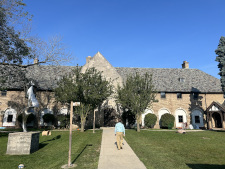 Milwaukee Country Day School
6255 North Santa Monica Boulevard
Whitefish Bay
Landmark Designation: 2024
Milwaukee Country Day School opened its doors to students on September 17, 1917, with 55 students. In 1964, Milwaukee Country Day School merged with Milwaukee University School and Milwaukee Downer Seminary. The combined school, the University School of Milwaukee, moved to a new campus in River Hills. In 1987, the Santa Monica Boulevard campus became the Milwaukee Jewish Day School, and today it is known today as the Max and Anita Karl Jewish Community Campus.
The 1917 school building, constructed in brick in the American Tudor Revival style, was designed by local Milwaukee architect Herman W. Buemming. Exceptional brickwork and half timbering of the Tudor Revival style are evident on the west side of the building as well as an elegant oriel window. Prominent gables over doorways are carved with decorative elements such as baseball bats and balls. The south entrance of the south building combines an oriel window, the half-timber front gable and half-timber elements above the brickwork. The interior design continues the half-timber elements in the stairwells, and the space that was formally the gymnasium is now an auditorium. A prominent limestone arched doorway greets visitors on the east side of the north building. Large arched windows are repeated along each corridor, allowing abundant light to enter the academic spaces. Within the main limestone arch are decorative carvings as well as the initials of MCDS. Along the east side of this building are whimsical sculptures celebrating the mission of this campus, strong academic training combined with physical development through athletics: owl of wisdom, bird with tennis racquet, monkey with baseball bat, dog with football, etc.


